So, I've noticed since I've been back that there's a certain flow to the conversations I have with people when they find out that I went to Ghana...
"How was it?"
Me "Amazing. Different." --These are the words I use most, because what else is there? The trip was not what you would call "fun". Although we did have a great time (and we had a lot of laughs), we weren't there to do the usual camera around the neck, socks and sandals, sight-seeing Western traveler thing. We were there to learn, to help where we could, and to find our niche of where we can help in the future.
This is when I decide whether the person actually wants to know what it's like in a developing country and what we did there or if they're just asking out of courtesy. Do I tell them about working with street children and passing the people begging for alms on the side of the road on scooter boards because the can't afford a wheelchair? Do I tell them about some of the practices they have for children born with a disability? Do I bring up the fact that preventable diseases such as polio, malaria, and AIDS run rampant and kill and cripple people daily and the individuals we interacted with who are affected by these diseases? Do I talk about the schools we visited and the lack of materials we take for granted? Do I discuss Ghana's Disability Bill and how far they have to go to reach a level of acceptance of people with disabilities? Or, do I tell them about the canopy walk in the rain forest and how beautiful the beach is?
After avoiding making people uncomfortable the first few times I was asked about my experience, I stopped. The issues need to be addressed and now 9 times out of 10, I do talk about the actual experiences we had and the issues Ghanaians and others in developing countries face. I have come to find that these are the issues that people love to talk about fixing, but when it comes to the awkward conversation about what is actually going on the conversation is avoided. Not anymore.--
"Wow. --the general response, regardless of whether I choose one of the first topics of conversation or the last, much more pleasant topic-- Would you go back?"
Me "Yes, in a heartbeat."
Sunday, June 14, 2009

Saturday, June 13, 2009
Adoteimon Child Development Center
For the 1st few days while in Ghana, we worked at the child development center that Sovereign Global Mission and the social work department at VCU are building. In addition to learning about the disability culture in the country and working with various centers and schools, we painted at the center. Even though it was hot and tiring work, I wholeheartedly supported the decision to complete community service work while we were there.

Painting the outside of the classroom building

Stacey (the shortest person there!) somehow ended up with a long-handled roller everyday

Painting the inside of a classroom

Posing with the professionals...they kept us in line
The child development center will serve as a school when it is completed for children in the village of Adoteimon. Adoteimon is a developing neighborhood about an hour outside of Accra. The homes in the community were built by Habitat for Humanity for families who raised 200 cedis (about $140) for their homes to be built. This center is where the library we collected books and donations for will reside. Although our books and bookshelves were still en-route, the library already has some books and shelves that Cameron (a VCU social work master's graduate who was staying in Ghana for a few months with Eric's family) was working hard to organize.
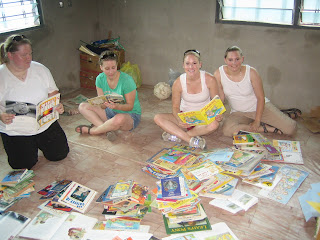
Reading in the library

Cameron posing with her hard work
On Saturdays, the children of Adoteimon are invited to gather at the child development center to read books in the library, to do crafts and, of course, to play! We were invited to join on our 1st Saturday and were told that there would be a few families attending who have children with disabilities. Eric and Felicia are attempting to begin a network of families with children with special needs in the community. Of the 10 who were invited, 2 came; 1 boy with paralysis in the lower limbs and 1 girl with undiagnosed Down's Syndrome. We were warned that turnout might be low because these families would be walking (in some cases miles) to get there.
We did a basic evaluation and consulted with the families on different strategies to perform exercises and stretch, remain active, and to learn in the home as neither child attends school. I was baffled to learn that the girl with Down's Syndrome was asked to leave school after biting her teacher who thought she was going to "catch" her disability. Although I had expected to run into a lack of understanding of disability, I was still taken aback by this reaction. This was a time when I had to remind myself of the cultural differences that exist and that I was in Ghana to learn about those differences, not to judge them. In an effort to expand the family's understanding of their child's disability (though not to diagnose it - just to be clear!), we armed them with a basic understanding of Down's Syndrome so that they might educate others.
After the evaluations were complete, we were able to play with the children in the community and they even put a play on for us (Where the Wild Things Are)! This was a great way to top off our time at the child development center and gave us a great introduction to the kinds of issues we were going to run into while working with individuals with special needs in Ghana.

Children reading and coloring with Eric

Performing Where the Wild Things Are

Painting the outside of the classroom building

Stacey (the shortest person there!) somehow ended up with a long-handled roller everyday

Painting the inside of a classroom

Posing with the professionals...they kept us in line
The child development center will serve as a school when it is completed for children in the village of Adoteimon. Adoteimon is a developing neighborhood about an hour outside of Accra. The homes in the community were built by Habitat for Humanity for families who raised 200 cedis (about $140) for their homes to be built. This center is where the library we collected books and donations for will reside. Although our books and bookshelves were still en-route, the library already has some books and shelves that Cameron (a VCU social work master's graduate who was staying in Ghana for a few months with Eric's family) was working hard to organize.

Reading in the library

Cameron posing with her hard work
On Saturdays, the children of Adoteimon are invited to gather at the child development center to read books in the library, to do crafts and, of course, to play! We were invited to join on our 1st Saturday and were told that there would be a few families attending who have children with disabilities. Eric and Felicia are attempting to begin a network of families with children with special needs in the community. Of the 10 who were invited, 2 came; 1 boy with paralysis in the lower limbs and 1 girl with undiagnosed Down's Syndrome. We were warned that turnout might be low because these families would be walking (in some cases miles) to get there.
We did a basic evaluation and consulted with the families on different strategies to perform exercises and stretch, remain active, and to learn in the home as neither child attends school. I was baffled to learn that the girl with Down's Syndrome was asked to leave school after biting her teacher who thought she was going to "catch" her disability. Although I had expected to run into a lack of understanding of disability, I was still taken aback by this reaction. This was a time when I had to remind myself of the cultural differences that exist and that I was in Ghana to learn about those differences, not to judge them. In an effort to expand the family's understanding of their child's disability (though not to diagnose it - just to be clear!), we armed them with a basic understanding of Down's Syndrome so that they might educate others.
After the evaluations were complete, we were able to play with the children in the community and they even put a play on for us (Where the Wild Things Are)! This was a great way to top off our time at the child development center and gave us a great introduction to the kinds of issues we were going to run into while working with individuals with special needs in Ghana.

Children reading and coloring with Eric

Performing Where the Wild Things Are
Thursday, June 4, 2009
A few lessons...
"Akwaaba!" This was one of the words I heard most from the people of Ghana. Akwaaba means welcome in Twi (in addition to English, one of the more common languages spoken in the country). "You are welcome, my sister" to our country, to our facility, to the restaurant, to my shop. Upon arrival to Ghana, stepping off the plane, these are the first words you see written across the entrance to the airport from the tarmac. Throughout my 2-week stay, I never once felt that I didn't belong or was in any way unwelcome.
"Obruni", meaning white person or foreigner in Twi is another word we heard quite a lot. I was even introduced to an Obruni dance (pictures soon to come!) by some of the street children we worked with during the feeding program hosted by Sovereign Global Mission on Sundays.
"Ghana Time" is something we certainly had to adjust to while in country. Nothing is worth doing if it has to be rushed and multi-tasking is absolutely unheard of. We found ourselves having to make a quick switch from our go-go-go Western attitudes to sitting back and relaxing. It's much too hot and humid to get worked up about being on time everywhere. "The traffic is too much" and we're going to be an hour late to our 9:00 a.m. meeting time at a facility? No worries! Sit back, grab a Fanta and some sugar bread, and enjoy the time with friends. The great thing about running late in Ghana is that chances are, the person you were going to meet is running late too. Here is a conversion chart from Ghana Time to U.S. Time (taken from Stacey's blog) that we worked out - while waiting for our driver who was running late...
5 minutes= 15-20 minutes
10 minutes = 45 minutes
I am there = 20 minutes
I am ready, I am bringing it, or I will come = ~30 minutes
I'll be right back or I am just going to the next village = 45 minutes-1 hour
I am in the traffic or The traffic is too much = 10 minutes- 2 hours
I am fixing the car = you should probably take a taxi or tro-tro
It is finished = never
Although we laugh about it, there's something to be said about slowing down. Although it's hard to slow down too much for fear of being trampled in America, I think there are little things we can do. Stop and have a conversation with the person standing next to you (no doubt waiting for something) in line. Get off your phone at the grocery store and talk with the cashier or instead of balancing your checkbook and folding laundry while waiting for dinner to cook, just sit outside. There's much to be gained from sitting back a little.
"Obruni", meaning white person or foreigner in Twi is another word we heard quite a lot. I was even introduced to an Obruni dance (pictures soon to come!) by some of the street children we worked with during the feeding program hosted by Sovereign Global Mission on Sundays.
"Ghana Time" is something we certainly had to adjust to while in country. Nothing is worth doing if it has to be rushed and multi-tasking is absolutely unheard of. We found ourselves having to make a quick switch from our go-go-go Western attitudes to sitting back and relaxing. It's much too hot and humid to get worked up about being on time everywhere. "The traffic is too much" and we're going to be an hour late to our 9:00 a.m. meeting time at a facility? No worries! Sit back, grab a Fanta and some sugar bread, and enjoy the time with friends. The great thing about running late in Ghana is that chances are, the person you were going to meet is running late too. Here is a conversion chart from Ghana Time to U.S. Time (taken from Stacey's blog) that we worked out - while waiting for our driver who was running late...
5 minutes= 15-20 minutes
10 minutes = 45 minutes
I am there = 20 minutes
I am ready, I am bringing it, or I will come = ~30 minutes
I'll be right back or I am just going to the next village = 45 minutes-1 hour
I am in the traffic or The traffic is too much = 10 minutes- 2 hours
I am fixing the car = you should probably take a taxi or tro-tro
It is finished = never
Although we laugh about it, there's something to be said about slowing down. Although it's hard to slow down too much for fear of being trampled in America, I think there are little things we can do. Stop and have a conversation with the person standing next to you (no doubt waiting for something) in line. Get off your phone at the grocery store and talk with the cashier or instead of balancing your checkbook and folding laundry while waiting for dinner to cook, just sit outside. There's much to be gained from sitting back a little.
We made it!
We made it back from our trip to Ghana! As the internet cafes in country were not stellar, I did not get the opportunity to update the blog while I was there. So, over the next couple weeks I'll be updating and talking about our experiences and what we hope to accomplish with future trips. Hopefully I'll be able to figure out how to post pictures and other fun stuff. Okay, so here goes...
Tuesday, March 31, 2009
Psychosocial Issues in the Disability Culture
Last week we discussed some of the psychosocial implications in which having a disability in Ghana may result. First and foremost, we discussed the social stigma associated with physical disabilities and other diseases, most notably AIDS. There are stigmas associated with physical disabilities in all cultures generally stemmed from how a person looks, moves, or ambulates. People with disabilities such as Cerebral Palsy or Amyotrophic Lateral Sclerosis (Lou Gehrig's Disease) are commonly assumed to have intellectual disabilities simply because their physicality can lead to mistaken assumptions. Neither Cerebral Palsy or ALS affect a person's cognition. These assumptions can have vast negative impacts on a person's psyche and especially in areas such as Africa, I'm sure we will run into instances where people have been discriminated against due to a misunderstood physical disability. AIDS is a disease in which people are especially discriminated against, to the point of being shunned from their village. In addition to the psychosocial impacts, this introduces health concerns.
While we're in Ghana, I'm certain that we'll encounter differing views on disability and I only hope that I can not only understand their views but perhaps provide understanding of different disabilities.
While we're in Ghana, I'm certain that we'll encounter differing views on disability and I only hope that I can not only understand their views but perhaps provide understanding of different disabilities.
Wednesday, March 25, 2009
Preparations and a Special Guest
As I continue to update the blog today...on March 4 we had a guest speaker from the social work department, Randi, come and talk to us about her experiences taking students to Ghana. She showed us a DVD she made about VCU social work in country and aside from it being amazing, it totally pumped me up to leave! Not that I need all that much encouragement. :-) She talked about what sorts of things we need to pack, what we need to do and what we need to avoid while we're there, and about the amazing people of Ghana. What struck me is the network of street children. For those of you who don't know (and I must admit that I didn't until recently), street children are orphans, children from bad family situations, or those who lost their homes and family who live on the street. It was fascinating to learn about how they take care of and rely on one another for support, money, protection, and encouragement. For example, Randi once gave a group a loaf of bread and instead of fighting over it, they meticulously divided the loaf so that each child got an equal share. A large amount of the children work for a living in dangerous jobs for little pay and are at constant risk of contracting diseases and infections such as Malaria. But, this is their way of life and from Orme and Seipel (Survival strategies of street children in Ghana), a boy stated "I think, tomorrow maybe I don't have money. So I will go and find some work to do. I will earn money tomorrow and buy some food which I will cook and eat."
Among other things, I am extremely excited to meet and interact with the people of Ghana, go to the market (which might be a bit overwhelming!), and visit the coast and the rain forest! But, in preparation for all of these exciting adventures, I'm first doing all the boring logistical stuff. Last Wednesday I got all of my vaccines (and subsequently couldn't raise my arms over my head for 2 days) and am in the process of filling out paperwork for my Visa. I've also begun to put my packing list together and am slowly acquiring all of the necessary *stuff* for the trip (at the top of my list is sunscreen, Deet, and Immodium). I figure if I make it to Ghana with those three things, I'll be ok. :-) Ghana, here I come!! Well, in 2 months...
Among other things, I am extremely excited to meet and interact with the people of Ghana, go to the market (which might be a bit overwhelming!), and visit the coast and the rain forest! But, in preparation for all of these exciting adventures, I'm first doing all the boring logistical stuff. Last Wednesday I got all of my vaccines (and subsequently couldn't raise my arms over my head for 2 days) and am in the process of filling out paperwork for my Visa. I've also begun to put my packing list together and am slowly acquiring all of the necessary *stuff* for the trip (at the top of my list is sunscreen, Deet, and Immodium). I figure if I make it to Ghana with those three things, I'll be ok. :-) Ghana, here I come!! Well, in 2 months...
Childhood Disabilities and Interventions
Back on February 25 (wow, where has the time gone?!), we had a meeting where we discussed some of the common disabilities, illnesses, and health conditions in Ghana. Obviously, AIDS is at the top of the list but I was surprised to learn that conditions such as Polio still affect children across the country. Stacey informed us that we are probably going to see children and adults with lasting after-effects of Polio and other seemingly simple fixes such as a child with Cerebral Palsy suffering from contractures (something that is avoided in the U.S. by splinting and proper use) or decubitus ulcers from lying in a bed or sitting in a wheelchair (something we would combat in the U.S. with pressure relief strategies and position-changes). It baffles me to think that we have access to vaccinations against diseases that are all but eradicated here in the states, but where we're going access to these vaccines, much less access to a medical facility, are considered luxuries (if they're considered at all). So much of what we're trying to do when we go to Ghana is to educate people about how they can help themselves and others around them. I only hope we can make a lasting difference on the people we encounter!
Subscribe to:
Posts (Atom)

